Trained with 100,000 samples in under 2 min on a desktop PC
Trotting and pacing policies trained with the proposed gradient using 100,000 samples in under
2 min on a desktop PC, deployed on hardware.
Abstract
This paper proposes a smooth analytic gradient for frictional contact and applies it to policy
learning and contact-implicit trajectory optimization for legged locomotion. The exact contact sensitivity is
available in closed form but describes changes within the current contact mode, providing no first-order
information toward neighboring contact modes. The proposed gradient replaces this sensitivity only in the
backward pass, leaving the hard-contact forward solve unchanged and the realized rollout feasible. A central-path
relaxation of the de Saxcé-corrected second-order-cone complementarity problem for Coulomb friction smooths the
conditions defining the separating, clamping, and sliding modes. The relaxed sensitivity is evaluated at a point
on the central path obtained by a Newton iteration initialized from the hard-contact solution. The sensitivity
remains continuous through contact-mode transitions and converges to the exact sensitivity as the relaxation
vanishes. Using 100,000 samples and less than 2 min of training on a desktop PC, policy learning with the
proposed gradient produces a policy that transfers to hardware without fine-tuning. On hardware, the robot under a
trotting policy withstands pushes and traverses debris and slippery ground. In trajectory optimization, the
proposed gradient reaches contact-rich solutions missed by exact and Signorini-relaxed gradients.
Method
Smooth gradients for frictional contact
Analytic contact sensitivity via relaxed de Saxcé‑corrected conic complementarity
Under hard contact, the exact sensitivity holds the contact mode fixed and gives first-order methods
no direction toward a neighboring mode. The proposed sensitivity relaxes the complete de Saxcé-corrected
frictional contact law, λ̃ ∘ σ̃ = 0, along its
central path, λ̃ ∘ σ̃ = ρe, in the
backward pass only. It provides directions toward separation, sliding, and clamping in every contact mode, so
policy learning and trajectory optimization can change contact modes through gradient-based updates.
Evaluating sensitivity at a relaxed frictional contact solution
The exact sensitivity is evaluated at the hard-contact solution, which lies on a cone boundary set by the contact
mode, so it holds that mode fixed; for example, dσ = 0 for a clamped contact and
dλ = 0 for a separating one. The proposed sensitivity is evaluated instead at
a relaxed pair inside both cones, found by a Newton iteration from the hard-contact solution.
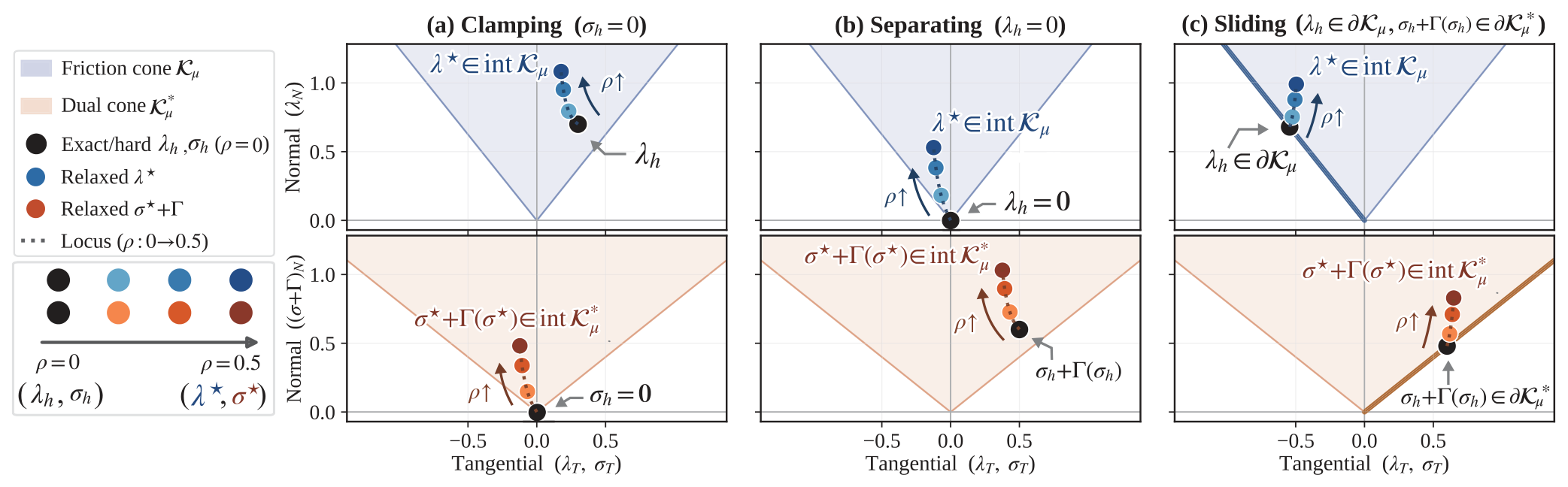
Fig. 2 in the paper. Central-path relaxation of the exact contact solutions in the clamping, separating, and
sliding regimes for a two-dimensional contact with μ = 0.8. The top row shows
the contact impulse λ ∈ Kμ, and the bottom row
shows the de Saxcé-corrected contact velocity
σ + Γμ(σ) ∈ Kμ*.
At ρ = 0, the clamping regime has
σh = 0, the separating regime has
λh = 0, and, in the sliding regime, both
λh and
σh + Γμ(σh) lie on their
respective cone boundaries. For ρ > 0, the corresponding relaxed
variables lie in int Kμ and
int Kμ*. Black markers denote the
exact solution. Blue and orange markers denote the relaxed impulse
λ* and corrected contact velocity
σ* + Γμ(σ*), respectively, for
ρ ∈ (0, 0.5]. Darker markers correspond to larger
ρ, and dotted curves trace the relaxed-solution loci as
ρ increases.
Sensitivity across contact-mode transitions
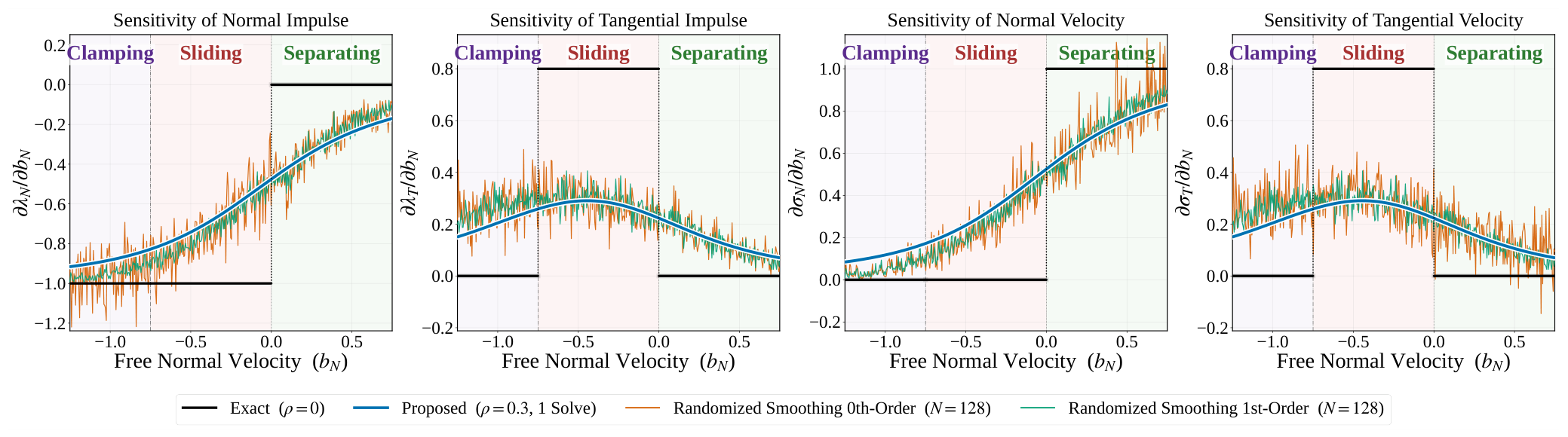
In this single-contact example, increasing the free normal velocity bN
moves the contact from clamping through sliding to separating. The exact sensitivity jumps at each mode boundary
and contains zero components from differentiating with the mode held fixed, whereas the proposed sensitivity is
continuous across these transitions.
Fig. 3 in the paper. Sensitivities of a single contact under the exact, randomized-smoothing, and proposed
gradients: the impulse and contact-velocity components with respect to the free normal velocity
bN. The point-mass model has diagonal A and
nonzero free tangential velocity bT. As
bN increases, the hard-contact solution changes mode from clamping to
sliding and then to separating. The exact sensitivity (black, ρ = 0) jumps at
the mode boundaries and contains zero components resulting from differentiation of the contact constraints with
the mode held fixed. Randomized smoothing with perturbation standard deviation 0.6 yields zeroth- and first-order
estimates using N = 128 perturbed solves per point. The proposed
sensitivity (ρ = 0.3) is evaluated deterministically at a single Newton-solved
central-path point for each bN and remains continuous across these mode
transitions.
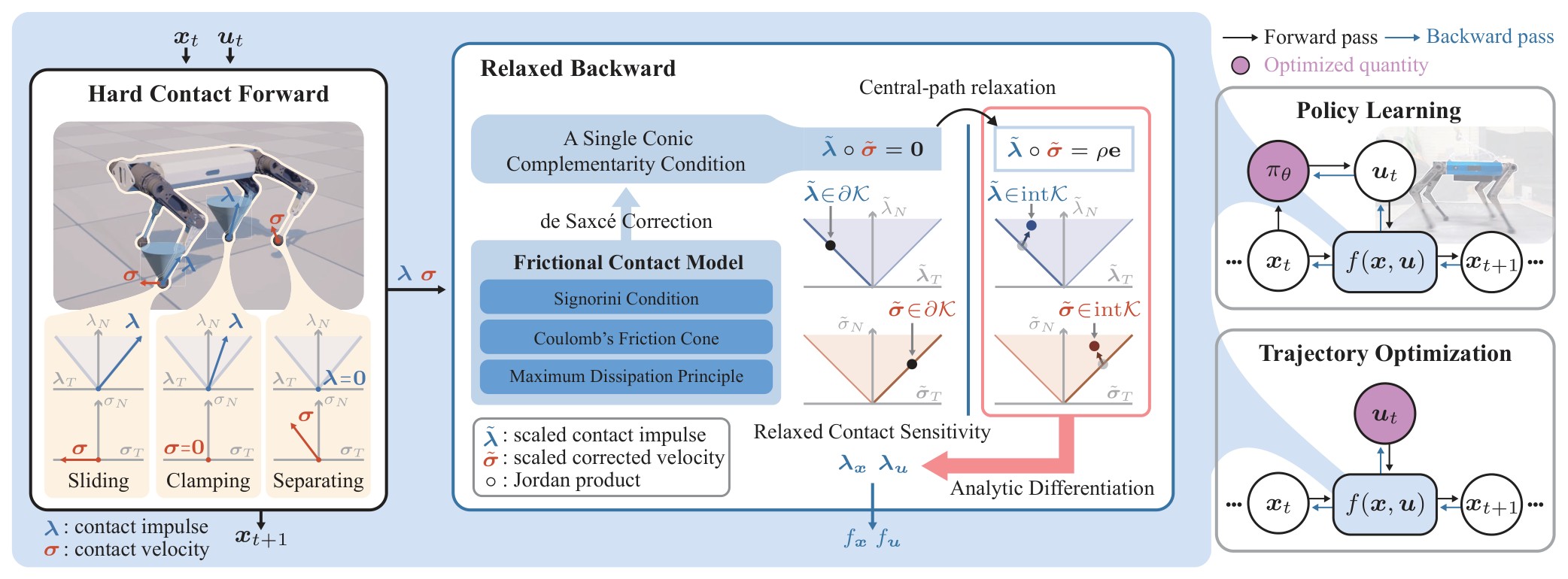
Overview of the proposed differentiable contact framework
The forward pass determines the realized transition with the hard-contact solve, and the relaxation is applied
only to the backward contact sensitivity. The proposed sensitivity replaces the exact one in the transition
Jacobians, fx
= ∂f/∂xt + (∂f/∂λ)(∂λ/∂xt) and likewise fu,
which enter the BPTT recursion for policy learning and the DDP backward pass for trajectory optimization.
Fig. 5 in the paper. Overview of the proposed differentiable contact framework. Given
(xt, ut), the hard-contact forward solve determines the
contact impulse λ, contact velocity σ, and next
state xt+1 under the realized sliding, clamping, or separating mode.
For the backward pass, the Signorini condition, Coulomb friction cone, and maximum-dissipation principle are
expressed as a single conic complementarity condition using the de Saxcé correction. The hard-contact solution
at ρ = 0 is relaxed along the central path to
ρ > 0, and analytic differentiation yields the relaxed contact
sensitivity and transition Jacobians (fx, fu). These
Jacobians are used for BPTT policy learning and DDP-based trajectory optimization.
Policy learning
Hardware demonstrations
Each policy is trained by BPTT with the proposed gradient in a single simulation environment and
deployed on the 45-kg quadruped without fine-tuning. On a desktop PC, the trotting and pacing policies are trained
on 100,000 samples in 108 s, and the low-friction gait-free policy on 160,000 samples in 172 s.
Trot, pace, and gait-free locomotion Trot and pace track commanded velocities on a treadmill
with their prescribed contact patterns; the low-friction gait-free policy walks without a prescribed
gait.Traversing debris The trotting policy traverses scattered debris while maintaining stable
locomotion.Push recovery The trotting policy withstands external pushes.Low-friction terrain On a boric-acid-coated surface with
μ ≈ 0.25, outside its training
range, the trotting policy recovers from intermittent foot slips and keeps walking without
falling.
Policy learning
Comparison with PPO
On the trot command-tracking task, BPTT with the proposed gradient learns the trot with one
environment (about 105 samples, 1.8 min). PPO with 8 to 32 environments does not track the
commanded velocities, PPO with 64 does not learn the trot, and trotting first emerges with 128 (about
107 samples, 17.7 min).
PPO
PPO with 8, 16, or 32 environments does not track commanded velocities, and PPO with 64 environments does
not learn the trot. The onset of trotting occurs at 128 environments.
Proposed (BPTT)
A single environment is sufficient for BPTT with the proposed gradient to learn the trot.
Contact-implicit trajectory optimization
Base-pose reaching via CITO
From the nominal standing pose, CITO reaches a reference base pose without prescribed contact modes or
foothold locations. The proposed gradient attains the lowest costs in translation, yaw, and pitch because it
provides search directions toward separation, sliding, and clamping in every contact mode.
No Relaxation
All four feet remain clamped, and the base twists relative to the fixed feet.
The feet separate or slide, but the front-right foot reclamps, preventing further
repositioning.
All four feet remain clamped, and the pitch stays below the reference.
Signorini-Relaxed
The base pivots about the clamped front-right foot, retaining leg twist.
The rear-right foot remains partially relocated, leaving the joints displaced.
The forward–backward base and pitch excursions are large.
Proposed
The feet are repositioned as the body turns, avoiding residual leg twist.
All four feet are repositioned as the base moves toward the reference.
The front feet are adjusted for balance, reducing the base and pitch excursions.
Contact-implicit trajectory optimization
Recovery from unmodeled external pulls
CI-MPC at 40 Hz holds a standing pose while 1-s pulls, absent from its prediction model, act on the
base. Averaged over eight directions, the proposed gradient withstands pulls up to 272 N, against 81 N
(No Relaxation) and 107 N (Signorini‑Relaxed), because the planned feet leave clamping and slide or
step with the base: their impulses oppose the pull, and the new footholds extend support.
No Relaxation
The front feet remain clamped, and the base tips forward.
The right feet remain clamped, and the base tips to the right.
The rear feet remain clamped, and the base tips backward.
Signorini-Relaxed
The front feet remain clamped, and the base tips forward.
The right feet remain clamped too long, and the base tips over to the right.
The rear feet remain clamped, and the base tips backward.
Proposed
The front feet slide forward with the pull and keep the robot balanced.
The right feet slide and step sideways with the pull and keep the robot balanced.
The rear feet slide backward with the pull and keep the robot balanced.
BibTeX
@misc{kim2026differentiablecontactdynamicslegged,
      title={Differentiable Contact Dynamics for Legged Locomotion: Policy Learning and Contact-Implicit Trajectory Optimization},
      author={Gijeong Kim and Seungbin Oh and Dongyun Kang and Hae-Won Park},
      year={2026},
      eprint={2610.35852},
      archivePrefix={arXiv},
      primaryClass={cs.RO},
      url={https://arxiv.org/abs/2610.35852},
}